Thursday, October 20, 2011
Physics, Engineering and Structural Design
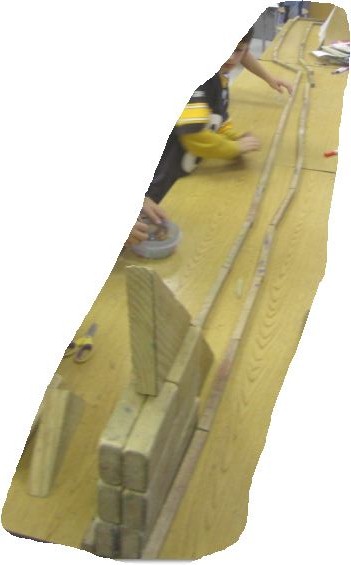
Kinetic art is fascinating! Engaging minds and hearts with simple materials like wooden blocks, cardboard and marbles has become a four dimensional staple of our art program since we obtained our first set of wooden blocks from Mr. Fralick. We have expanded our block building work to include ephemeral expansive marble run pieces. Many of our children look forward to creating simple machines and experimenting with gravity, friction and simple structural elements like columns, beams, plates and arches with cardboard and wooden block marble runs. There is just something so cool about working with Newtonian mechanics in the art room. E=mv^2.




Wednesday, June 15, 2011
Blocks Paper Scissors Blog Site....
Check out this link for camp updates: www.blockspaperscissorscamp.blogspot.com .
Monday, April 25, 2011
Summer Art Camp Preview


Clark Fralick is the AEAI 2004 Indiana Art Educator of the Year and Clyde Gaw is the AEAI 2005 Indiana Elementary Art Teacher of the Year.
In 2003 Clark and I did a summer art camp at New Palestine Elementary. As I recall, that camp was a pure blast. We took over the music room and the art room with over 60 kids. Lots of creative activity and lots of fun!
In 2009 I did a solo camp at Indianapolis Public Schools. You can read about it here:
I can guarantee this upcoming camp will include drawing, painting, collage, cardboard construction, sculpture, paper mache, puppetry, jewelry, weaving, textiles and lots of outdoor art activities, weather permitting.
Clark and I, have presented at national and state forums on child centered art education practices and belong to an international group of art teachers who advocate for child centered art education learning experience. Teaching for Artistic Behavior (TAB) has been around since 2001.
Sunday, April 24, 2011

Saturday, April 23, 2011

More choice based art at the Hancock County Art Show!
The marble runs were a big hit at the County Art Show. Mrs. Hall, the art teacher at Greenfield Central Junior High School, the host of the show, told me her 7th and 8th graders wanted to make marble runs too!
I think the marble runs have provided one of the most satisfying building/construction experiences to our students ever.
Working with gravity, slope and basic attachment techniques has never been more gratifying.
I think the marble runs have provided one of the most satisfying building/construction experiences to our students ever.
Working with gravity, slope and basic attachment techniques has never been more gratifying.

Hancock County Art Show

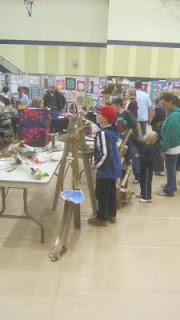
A patron of the Hancock County student art show, checks out some of the child centered art on display from New Palestine Elementary on the left side of this photo.
NPE Fine Arts Festival Pics


My sincerest thanks to my principal Mr. Kern, my colleague Mrs. Roudebush and our wonderful Fine Arts Festival Volunteers, Mrs. Smith, Mrs. True, Mrs. Mattingly, Mrs. Hockett and Mrs. Martin for helping me to set up this huge show! I estimate there were about six hundred works of art in this exhibit and I could not have done it without these folk's help! My sincerest thanks to all who helped me with set up and take down.
Sunday, April 10, 2011
Blocks-Paper-Scissors!

Clark and I will have a great camp at Indy Park's Post Road Park Community Center. My sincerest thanks to Post Road Park Manager Linda Fink for hooking us up!
We hope to have 40-50 attendees pr. week. Our activities will include, but are not limited to: drawing, painting, collage, cardboard construction, block building, puppetry, textiles, jewelry making crafts and photography.
Clark and I have approximately 50 years experience between the two of us working with elementary aged kids. We are hoping to fill the camp with at least 40 participants for each week. Any parents who are interested in providing their kids with a dynamic art education experience, should consider this camp for their children.
Check out this blog for more info on what we have been up to since 2004. Enjoy!
For questions related to the camp, or if you would like to reserve a spot on our participants list, you can send me an email here: campak14@yahoo.com
Friday, March 25, 2011
Art or Engineering?

When do the boundaries between art, sculpture and engineering blur? It happens all the time in choice based art programs. When children engage in interdisciplinary learning activities, there is nothing contrived about their motivation to do so.
There are about two dozen marble runs stored away in the art room...we are bursting at the seams...trying to store all the sculpture and art, getting it ready for our upcoming April 18th Art Show. Can't wait to post pics from that event!
More later....cg

Thursday, October 14, 2010
Southern Hancock School Funding Referendum

Greetings to all of the readers here at "Transition to Choice Based Art Education."
This year, the children at New Palestine Elementary are thriving once again in our choice based art program.
Today, I spoke with about twenty or so parents about their children's art education experiences during our annual teacher/parent conference day. One of the fascinating parts of our discussions was the observation that the children are very much engaged in similar kinds of art making experiences at home as they are in the NPE art room.
Some of the children are so engaged in self directed art making at home, that it has become startling.
One mother told me how her son has appropriated her hot glue gun and has manufactured numerous cardboard model airplanes and other vehicles that are strung out all over his bedroom. "I have to sneak the old sculptures out when he is not looking because they are all over the place! Thanks a lot Mr. Gaw!" she told me with a smile.
"Houston, We Have A Problem"
Sadly, I am not happy to report, our school district like many school districts across the country is suffering from a shortage of operating funds.
Realistically, I have to believe, this development has put the viability of future choice based art education program experiences for the children of New Palestine Elementary in jeopardy.
Fortunately the administration of Southern Hancock Schools and a significant number of community members in New Palestine are working to pass a referendum in order to strengthen our schools and to keep important educational programs like elementary art and music in the curricula.
If you live in our district and would like to learn more about what you can do to support the Southern Hancock Schools pass the education funding referendum, check out this link: Vote Yes!
Wednesday, August 04, 2010
More on Fantasy Violence in Children's Art

Excerpts from "The Secret Art of Boys."
Under the guidance of educators who are interested in facilitating personalized pathways to creative experience, children and in particular boys, will thrive in learning environments where ideas related to super heroes, monsters, villains, military action, and other aspects of their make believe worlds can be expressed. Just as fantasy violence can be a part of children’s play i.e. cops and robbers, super heroes or war play (Brown, Gurian, Kindlon & Thompson 00, Jones 2002, children will express fantasy violence in the art they create (Duncum 05, Rubin 05, Lowenfeld 57).
Many educators, who might consider such content inappropriate for school and resort to censorship, miss out on opportunities to integrate and synthesize essential learning into children’s desire to express make believe violence in their fantasy art. Art teachers sensitive to child centered learning may view children’s decisions to express fantasy violence as a means to facilitate profound educational and creative growth experiences.
Concerns that art expressing fantasy violence will lead to real violence are unfounded. When rare events of lethal violence are fully examined, the motivations for committing such heinous acts are clearly related to revenge motives and victim mentalities. A common thread in these acts is the transmission of actual threats in spoken or written forms. Other red flags to consider in the context of an individual’s normal behavior might include changes in their appearance and changes in friends, frequent use of inappropriate language, changes in personal habits or humanitarian or religious values and episodes where individuals are quick to anger, cry or reveal other unstable emotions (Hollowell ‘05).
Fantasy violence and play violence is what it is: fantasy and play. Play is a natural form of learning and one of the ways children learn best. Play is fundamental to intellectual development. Just like real artists it is not uncommon for children to play with ideas, materials and techniques in choice based art programs. The concern that real violence can be triggered in children who engage in artistic activity related to their fantasy play, contradicts what we know about creativity.
The creative process strengthens children’s self confidence as new concepts, objects, ideas, and performance skills are born from individual or collaborative efforts. Conceiving and solving artistic problems in a state of creative flow has the affect of releasing tensions, anxiety and ameliorating violent or aggressive dispositions (Lowenfeld ‘57, Rubin ’05, Csikzentmilhaly ‘99, May ‘75).
Brown, S. (2009) Play: How it shapes the brain, opens the imagination, and invigorates the soul. New York, Penguin.
Csikszentmihayli, M. (1996). Creativity: Flow and the Psychology of Discovery. New York, Harper Collins Publishers, Inc.
Lowenfeld, V. (1957). Creative and mental growth (3rd ed.). New York, Mcmillan.
Hollowell, Perry "ACTIVE SHOOTER PREVENTION MATRIX". Law & Order. FindArticles.com. 04 Aug, 2010. http://findarticles.com/p/articles/mi_7649/is_200806/ai_n32285293/
May, R. (1994), The Courage to Create. New York, Norton Publishers.
Rubin, J.A. (2005). Child Art Therapy. Hoboken, New Jersey, John Wiley and Sons, Publishers.
Monday, July 05, 2010

The Secret Art of Boys

My friend and colleague Clark Fralick, wrote a paper once entitled, "The Secret Art of Boys." In 2008 we did two presentations of the same title, one at the Art Education Association of Indiana state conference, and the other in New Orleans at the National Convention. Here is the crux of the matter: A vast segment of boys (and girls) love to create art based on their imaginary realms. Guess what is inside there? Make believe weapons, fantasy violence and lots of mayhem and conflict. This is controversial stuff.
If a kid get's caught making art containing fantasy violence in many schools across the U.S., he or she can get into big trouble. When I see children's art in my room that contains fantasy violence, I ask questions. What I know for a fact, is that fantasy violence is a natural part of a child's development, and it is better to provide for self expression than it is to censor the child.
From the research I have conducted (Lowenfeld: "Creative and Mental Growth," Michael Thompson: “Raising Cain,” Rubin: "Child Art Therapy," May: "The Courage to Create," Jones: "Killing Monsters: Why Children Need Fantasy, Super Heroes, and Make-Believe Violence," Tyre: "The Trouble With Boys," etc.) and classroom observations I have made, children will thrive in learning environments where they may express such ideas. The creative process ameliorates children's tendency toward aggressive behavior despite the fantasy violent content, the individual's active imagination is stimulated to a very high degree and there are many other developmental and educational benefits associated with art making of this nature. Fantasy violence is just that, fantasy. The act of working from one's fantasies is more closely related to a state of fantasy play than to a state of deviance.
When to draw the line? In rare, extreme cases, when the art is related to real threats then teachers need to investigate and take action. In the mean time, it is important for teachers to consider the short and long term consequences of censorship.
Know your students, ask them questions related to their art, continue observations and dialogue. The benefits of meaningful learning experiences and fully engaged students are profound and life changing.
Here is an excerpt from Chapter 11 of The Learner Directed Classroom," written for Diane Jaquith and Nan Hathaway entitled, "The Secret Art of Boys."
“Bomb!” Seven year old John warns his classmates. “Kaboom!” He fires pretend magic marker missiles into hostile army figures depicted on a large piece of paper. John re-arms himself with oil pastels and unloads a barrage of machine gun bullet lines into the battle zone. “tffffffff…tfffffff!” He loads a stubby brush with tempera paint and thrusts it into blast fragments of jagged lines and shapes. “Look at that! A bomb! He got shot!” One of the characters in the battle scene is wounded. “Kaboom!” John’s collaborators Frank and Jimmy enter the fray. The trio of make believe warriors, re-arm themselves with new magic markers and slice colorful lines into the picture. After a prolonged exchange of simulated gun and missile fire the energetic war artists decide to expand their drawing with more glue and paper. As the battle spills into new territory, more soldiers, tanks and fighter jets are added. The battle rages on. The boy’s art work soon resembles a Cy Twombly abstraction (1). Later, the boys excitedly call their classmates over to share stories about their picture. After two more class sessions, the battle illustrators add crayon resist painting techniques and more colored pencil and oil pastel. Paper towels are used to blend areas representing fire and smoke. The boys are physically and emotionally in the imaginary battle, immersing themselves in the roles of U.S. military personnel with weapons of power. The boy’s teacher transcribes their stories into artist statements:
John: “It started with a little battle with Frank and Jimmy. And then we started to connect a big thing. I started the very, very first one and then we connected it.”
Frank: “This is a tank and somebody drew over it, but I could draw over it because there was a replacement tank. I air-striked their ship.”
Jimmy: “In this one part, there is a flying tank, and he shot the bad guys ship and the bad guys had one hundred ships, fifty on each side. So we shot both the wings off so they would all be dead.”
At the county art show, the boys proudly show their collaboration to family members who soon discover the 20 square foot multi-media drawing is the largest 2-dimensional work and among the most visually exciting in the entire 5000 piece, K-12 art exhibit. Proud parents take pictures of their sons next to the huge drawing followed by comments of approval and congratulations on a job well done. Back in the classroom, the boys negotiate to divvy up the mural, cutting it into pieces and take their favorite parts home.

Friday, April 23, 2010


Art Show Pics

We are exhibiting about 200 works at our county wide art show right now. Here are some pics from that exhibition. Note the Egyptian themed works. Our music teacher, Heather Leichty visited Egypt last summer on a Lilly Grant, and through her experiences, children learned much about Egyptian culture and history. Naturally, we expanded upon Egyptian art and culture here in our choice art room and implemented lessons on tomb building, mask making, drawing and painting and much conceptual work related to questions about how the pyramids were built. We even built two royal sarcophagi and a paper mache mummy!
Naturally, kids express the important ideas about what they are learning into their art.
Friday, April 16, 2010
2010 Youth Art Month Speech
Here is the 2010 YAM keynote address.
My special thanks to Sue Perry who coordinated our YAM event and also to Dr. Brad Venable who has been instrumental in leading AEAI through turbulent times.
My special thanks to Sue Perry who coordinated our YAM event and also to Dr. Brad Venable who has been instrumental in leading AEAI through turbulent times.
Tuesday, November 10, 2009
Invention Center!
 One of our most popular centers, this one even has hot glue guns! Here is the place you can come by to explore ideas related to cardboard and paper construction. We have engineers who design airplanes, catapults, space craft, boats, robots and a multitude of other futuristic creations.
Saturday, November 07, 2009
The Block Center


Our children love to work in the block center. It is a place where mysterious, adventure filled environments can be created. The block center is always busy where construction crews and designers engage in creating cities of the future and recreate battle scenes from recent history and the distant future. There is always a story to be told here, problems to be formed and solved. The block center is one of our most important centers in the NPE Art Room.
Subscribe to:
Posts (Atom)