Sunday, March 30, 2014

A Structure That Supports Freedom of Thought

One of the absolute fundamental benefits of choice based art programs is the support, space and time that teachers provide children to realize and exercise their freedom of thought. Within this structure exists the realm of free inquiry, freedom of expression and free creation.
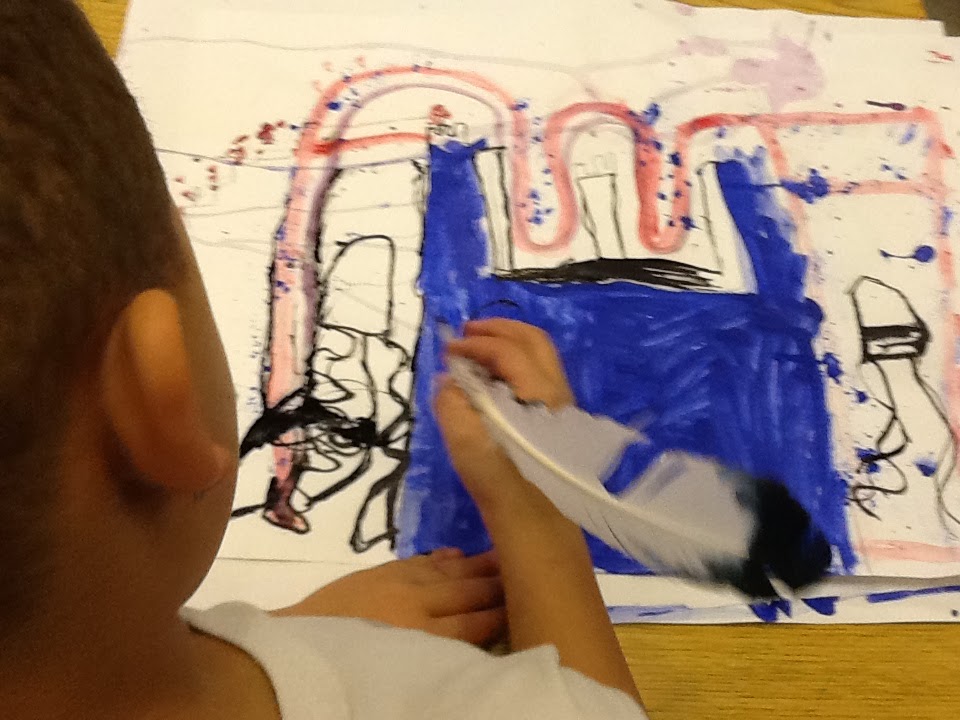
A 2nd grade student explores her ideas about color, line, composition and rhythm in a tempera painting.
Sounds easy but implementing a structure for freedom within institutions that seek to control inputs,  outputs and children's actions is a bit of a paradox. Do children co-construct the curriculum in other subject areas within American K-12 education? Unless children attend a private independent school, in today's high stakes standardized test mandated K-12 education climate that answer for the most part is no.

A hallmark of any educational institution or democratic society is how it provides learners with opportunities to develop their innate talents, gifts and passions as free human beings. Authorities should be challenged to this point. How does the World's most important democracy recognize humans as unique individuals and how do we educate them to operate within a free and open society?

Providing children with opportunities to co-construct learning experience provides them with opportunities to exercise free will in the context as a natural learner free from coercion and maximizes the potential of such experiences to provide new pathways to realize unique and innate human characteristics.

Friday, March 28, 2014

Lowenfeld: Every Human Being is Endowed With A Creative Spirit


2nd grader experiments with shapes and composition utilizing tempera paint.
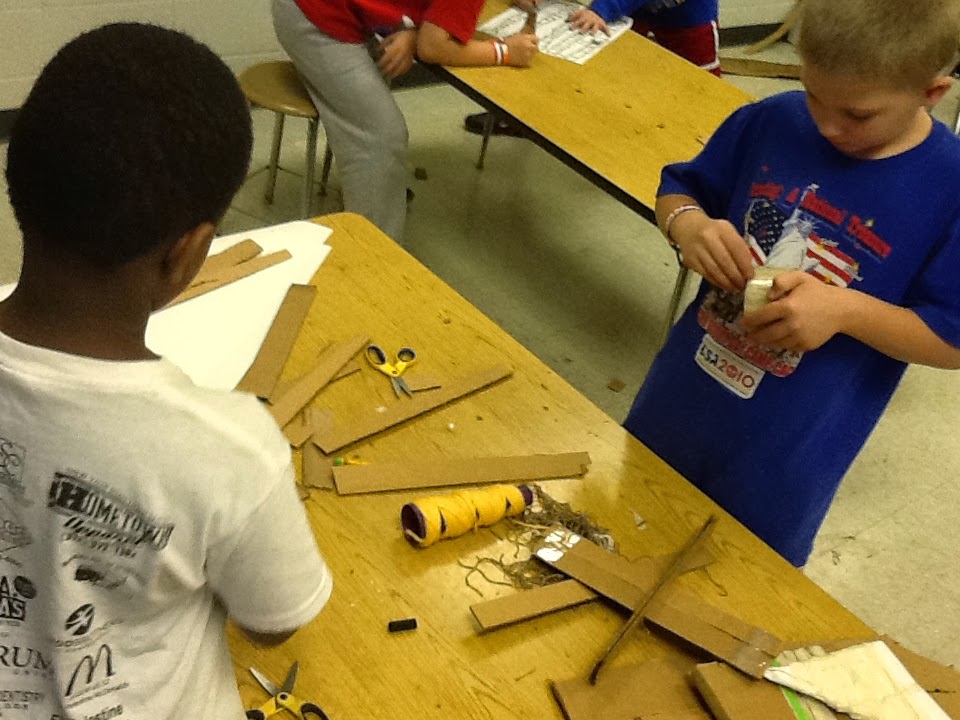
4th grade boy builds a cardboard airplane model.
2nd grader investigates a small object utilizing a microscope.
6th grader shows off her cow sculpture.
How do we support that creative spirit? Viktor Lowenfeld had observed years before Howard Gardner's work on multiple intelligences, that we are born with innate capacities and in varying degrees. Choice based art rooms support children's innate creative intelligences.  Optimizing learning experience within heterogeneous communities becomes a matter of stimulating learning through the creative spirit. It also means awareness and basic understanding of emergent curriculum, cognitive development, constructivist learning experience and designing specialized learning environments to facilitate self-determined, self directed learning experience.


Monday, March 24, 2014

TAB Seminar Information Flyer

After checking out the lineup, the setting and the schedule, this professional development event looks to be exciting and historic!
Flyer designed and authored by Diane Jaquith

Wednesday, March 19, 2014

Learning About One's Creative Capacities

I rubbed chalk all over a paper then I put paint all over it. Next I put dots all over the paper and outlined them. And that was how I made it.
Artist statements reveal much about a child's creative process. These windows into the learner's creative capacities reveal degrees of independent thinking, unique interests, attention to learning activity and confirmation of uniqueness and individuality.

Learner directed experiences matter because when learners are outside the structure of the classroom, what structures are they left with to support the continuation of their creative thinking? The truth? They are left with memories of their experience. How interesting the activity is to the learner determines how much attention the learner is going to invest into the learning event. How attentive were children during their learning activities?  How deep and compelling the experience is, and how much of the learning process the learner accepts into his or her character, determines how long memories and learning will last. This process can become cyclical.

Choice art teachers provide learners with ample opportunities to develop authentic multi-sensory, trans-disciplinary learning experiences, generated from and attached to existing memories and interests that have deep roots within the mind.

Affirming children's time sensitive ideas, allowing them to discover their own styles and capacities for independent thinking will unlock their emotional drive and set them on a course toward future self-directed pathways where they become confident, active, independent learners and metacognitive thinkers.

Tuesday, March 18, 2014

What Do Student Artist Statements Reveal? Experience Matters!

I am Andy. I like colors. Thats it! Andy Grade 1
We are good friends. P.S. Have a good day! Katie Grade 1
We love to draw. We love art. Hayden Grade 1
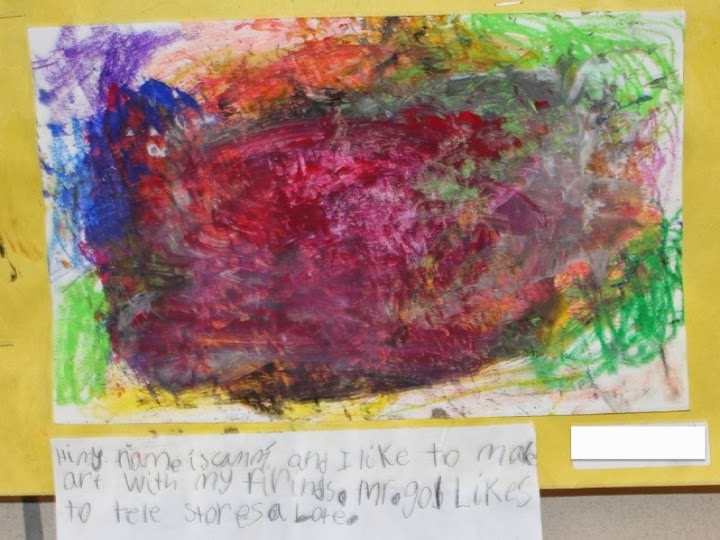
Hi my name is Cam and I like to make art with my friends. Mr. Gol likes to tell stores a lot. Cam 1st Grade

I got inspired by this painting. I thought I should do some dots but then it was blank so I came up with this idea.
Mia 3rd grade
Hi my name is Sophie. I love art. I love to draw. I love making my picture colorful and color over over on the same paper I love rainbows and colorful things. I have a lot of feelings in this picture.
This is Sheutmon X7 it is the 7th fusion form of Sheutmon it is the most powerful Digimon in the World! Brandon Grade 4 
Hi. My name is Maddie. I love art. It's fun to add paint and color to everything. I thought of doing this because it's fun to hide little things in your drawing. I love designs and color. Thank You! Maddie Grade 5
John Dewey noted in "Art As Experience," that viewers of art objects or final artistic outcomes are many times unaware of the internal experience that takes place within the minds and hearts of the artist during the creative act. That aspect of the creative act is all too apparent when viewing children's self directed art and reading the accompanying artist statements. One thing viewers notice when viewing a TAB student art exhibit is that children practice the conceptual work of art making and take ownership of the ideas behind the final art products. In choice based art programs, children's ideas matter!

Tuesday, March 11, 2014

2014 Indiana Youth Art Month Remarks

My sincerest thanks to Kheira Adda, Mindy Stephenson, Sidney Allen, Terri Nagle, Bev Staub, Allie Staub and all the AEAI Youth Art Month volunteers who made this exhibition such a special event! Here are my remarks to the students, parents and citizens who attended this wonderful exhibition of Indiana K-12 drawings, paintings, collage and printmaking art display held at the South Atrium of the Indiana State Capitol!

Photo by Terri Nagle.
Good Afternoon!


I wanted to say something to you about the arts and the formation of mind, but my students at New Palestine Elementary always tell me I take up too much of their art time because I talk too much so I will try to be brief.

200 years ago, in the town of Dole, France, a boy was born to poorly educated parents. Early on, he was not very astute in academics, however, he showed an immense interest in drawing and painting. He devoted much of his early life to art and at one time considered work as a professional portrait painter. As he grew, his interests turned to science, and later he decided to use his powers of imagination in science laboratories. This former art student would go on to a spectacular career in bio-chemistry and is responsible for developing numerous scientific breakthroughs in germ theory, the science of vaccination and pasteurization. Of course I am talking about Louis Pasteur.  Pasteur credited his early art training as providing him with the capacity to envision cellular activity at microscopic levels. On the relationship of art and science Pasteur said, “The illusions of the experiment form the greater part of my power!

Art making has immense psycho-dynamic power to imbue in children the attributes of imagination, observation, intellect and perception that will serve them well into their adulthood. Think about it.The only subject in school that is a bonafide medical therapy is art. Art is powerful stuff. Art is science! 95% of the World’s top STEM professionals all have fine arts backgrounds. Art education is a good thing!

Unfortunately, I leave you today with sad news. Throughout our state, we have witnessed art programs cut and creativity development reduced in our public schools. High quality art programs are at risk across this state. Real dollars reaching Indiana classrooms have declined since 2002 by at least 20%.


If you would like to advocate for your children’s art program, I urge you to contact your legislators at IN.GOV. Send your federal legislators, send your governor and send your president a loud and clear message either by telephone or by email to adequately fund Indiana public schools and preserve fine arts programs for your children and our future. 

We cannot afford future failures of imagination! 
I thank you!

Saturday, February 01, 2014

TAB Institute: Professional Development For Holistic Integrated Thinking Through Art Education

The TAB Institute will be held at the Massachusetts College of Art and Design in Boston, Massachusetts July 13-19, 2014.


What is the TAB Institute?
This one-week Teaching for Artistic Behavior course offers intensive inquiry into the practice of choice-based art education for beginning and experienced TAB teachers. This is the only course exclusively offered by the founders of Teaching for Artistic Behavior. This course is available for graduate credit.

Where will the TAB Institute be located?
The setting is Massachusetts College of Art and Design (MCAD), located in the Fenway neighborhood. MCAD is in close proximity to two world class art museums, the Boston Museum of Fine Arts [Link:  http://www.mfa.org/] and the Isabella Stewart Gardner Museum [Link: http://www.gardnermuseum.org/], as well as historic Fenway Park [Link: http://boston.redsox.mlb.com/bos/ballpark/index.jsp], home to the Boston Red Sox.

What are the dates?
The TAB Institute will take place from 4 p.m. Sunday, July 13 – Friday, July 18. The Institute will conclude at 2 p.m. on Friday to accommodate travel plans.

The faculty is comprised of TAB founders, including Katherine Douglas, Diane Jaquith, Nan Hathaway and Clyde Gaw.

What does the daily schedule look like? 
Daily instruction will be delivered in two tiers, Beginning (Track I) and Established (Track II). Following breakfast in the Arnheim Gallery, the two tracks will meet separately for 1-2 hours. All participants will come together mid-morning for a range of presentations by additional speakers. Each afternoon a different 3-hour activity will take place, including a collective art making experience, museum visit, studio artist visit, and an “Unconference,” where participants determine the content. Evening workshops will include studio center design, classroom overviews, and topics for instruction.

Are the evening workshops required?
Those seeking graduate credit will need to attend the entire Institute in order to earn 45 credit hours of contact time.

How will I know which Track to select?
Track I: Track I is for beginning and established teachers who are new to TAB. Participants will acquire plans, tools, and strategies to fully implement a choice-based art curriculum in their own setting. Topics include:
Setting up Studio Centers
Shifting roles from teacher-directed to learner-directed
Demo Lessons
Student Learning Objectives Curriculum Mapping Authentic AssessmentTrack II: Track II is for teachers who have implemented a modified-choice or full-choice art program for at least one year. At the end of the Institute, participants will be able to identify the diverse needs of individual students and demonstrate how student learning objectives for all learners can be met through TAB classroom practices. Topics include:
Learning Theories Special Populations Personalized Learning
Feedback and questioning strategies
Collaboration
Emergent Curriculum

Is the Institute differentiated by level?
There will be opportunities for participants to group by level: pre-K-5, 6-8, and 9-12 during the afternoon and evening sessions. Some of the mid-morning presentations will also focus on elementary and secondary topics.

How do I get there?
For distance travelers, Boston is best accessed through Logan Airport or Amtrak. Boston is a walking city with excellent public transportation. MCAD is located directly on the MBTA Green Line, Longwood Medical stop (E train, Heath).

What do I need to bring?
Participants should bring the required readings, laptop or tablet. Rooms will be air-conditioned so a light-weight sweater would be a good idea. Boston is a walking city so good walking shoes are recommended. Basic art materials will be provided to replicate
studio center experiences. MCAD sells artist materials in their campus bookstoreWhat are the requirements for graduate credit?
Pre-Course preparation includes readings, online forum, and Pinterest
45 hours contact during Institute
Post-Course project

Will MCAD credits be accepted by my school district?
Students registered for credit will receive letter grades. Students seeking credit for career enhancement or reimbursement are urged to contact their home institutions to arrange prior approval. Course credit is not automatically transferable; policies on transfer credit vary by 
institution and by program, so it is important to seek the approval of your advisor before 
you register. Registration for credit must occur before the class begins.

How much does the TAB Institute cost?
Course
For three graduate credits, the fee is $1910. 
To audit the course, the fee is $675.

Housing
Two-bedroom suites have a shared bath, available Sunday through Thursday, Friday night is optional. The workshop rates for single and double rooms are:
Double: $55/night per person
Single: $75/night per person

Parking
Parking will be available for $25 for the week.

Meals
Breakfast Monday-Friday and two dinners, Sunday and Thursday nights, are provided with registration. For other meals there are many inexpensive dining options in the neighborhood, including the Dining Commons at MCAD.

How do I register?
Registration for the TAB Institute will be through Massachusetts College of Art and Design’s Professional and Continuing Education Program. [Link: http://www.massart.edu/Continuing_Education.html]  Registrations open in February. Those interested in receiving an email announcement when registration is available can email Katherine Douglas at twoducks@aol.com 

Policies on Payment
A $300 non-refundable deposit is required to register. The balance will be due on June 1. Participants who withdraw prior to July 1 will receive a refund, minus the deposit. After July 1 no refund will be provided for withdrawal from the course.


Monday, January 20, 2014

TAB Colorado 2014: Professional Development of the 1st Magnitude

Wow! I am so indebted to Dale Zalmstra, Cynthia Barnes and Adam Laughlin for a wonderful  professional development experience! What was most inspirational was the fact that these three K-12 art teachers have been coordinating with the University of Northern Colorado Art Education Department and have put together a stellar professional education conference experience for the past three years! All professional development should enable teachers to take away valuable resources and knowledge and I observed some of the most inspirational presentations and excellent assessment development workshops related to authentic learning experience in my career here. NAEA doesn't have nothing on TAB Colorado! Many, many thanks to the art education staff at University of Northern Colorado including Connie Stewart and Patrick Fahey and Aurora, Colorado Public Schools.  I was so happy to visit with Mary Olson and Roni Rohr of New Mexico! I met many new colleagues including Jay Horn, Jen La and Keziah Kelsey.

Many, many thanks to Dale and Steve Zalmstra, and Kevin and Deb Gaw for hosting me during my stay in Denver!

Here is a link to the video recorded and posted by Adam Laughlin and Cynthia Barnes of my talk.

Saturday, January 11, 2014

Colorado TAB 2014


I am most humbled and honored to have been invited by Cynthia Barnes, Dale Zalmstra and Adam Laughlin to speak at the 3rd Annual Colorado TAB Conference this coming January 18th. I am looking forward to visiting with all the educators who work in and near the Mile High City!  More info on this exciting conference related to one of the most important pedagogical developments in American education is here:

Friday, December 27, 2013

The Secret Art of Boys: A Post Script


If you believe that human beings have inherited a great deal of their thinking capacities from an ancient genetic lineage as do I, it is not hard to recognize that constructivist forms of thinking, learning and doing begin at birth.  Mediated through our cognitive, sensory and emotional realms, information is then transmitted to our formative minds where we make sense of it. How to make sense of this World?
An eight year old boy depicts a siege battle of a medieval castle.
From a young child's perspective, I believe it is difficult to understand how weapons of power can take life. The taking and ending of life with objects of power is a concept that compels fascination. Thus, for many children seeking understanding of this World, a fascination with weapons technology and fantasy violence can easily take hold of their imagination.

People have been fascinated by objects of power since the beginning of time. Human interest in power and coming to terms with this power through artistic expression is innate. The earliest examples? Prehistoric cave art. Let's take a look inside the Hall of Bulls at Lascaux. It should be noted by the reader that the bulls depicted by the artists of Lascaux are not the same domesticated bovine we recognize from our modern era. The bulls of Lascaux are aurochs. Aurochs were powerful and dangerous animals feared by prehistoric hunters. Skeletal remains reveal creatures with unbelievable power, over six feet at the shoulder, weighing in over 1000 lbs. and with horns over a meter in length. Aurochs dominated the landscape of the European Paleolithic era and dominate the viewing space within the confines of Lascaux.

Like the early artists of Lascaux, children develop a fascination for objects of power and it is not surprising that for many young artists, representations of power dominate their imagination and their art.
A six year old boy animates his monster puppet with scary noises.

Thursday, December 12, 2013

Sunday, December 01, 2013

Is The Creativity Organ Innate?

Children work and collaborate from their independent ideas.
To answer my own question: YES! Just as the language organ is innate, the creativity organ, that which has been endowed in us through the Forces of the Universe, is innate also. How do choice based art teachers nurture and protect those aspects of children's unique capacities? Choice based art teachers provide children with time to find and develop their unique gifts, talents and interests. Choice based art teachers support children's natural drive for inquiry and nurture curiosity. Choice based art teachers provide children with ways to design their learning activities and direct their own learning. Finally, choice art teachers support children's capacities to develop and refine their own ideas. Opportunities to provide children with experiences related directly to their creative thought  is a hallmark of choice based art learning pedagogy.  Choice based art education is educating for human greatness. Choice based art teachers recognize there is something special and unique in each and every child that enters the art room. Building on the strengths of children can be a starting point of the curriculum if the teacher wishes it so.

Tuesday, November 12, 2013

Explore, Discovering New Approaches To Teaching Visual Arts

I am much indebted to Dr. Lisa Jameson for inviting me to participate in the Northern Kentucky University visual arts regional conference.
How do learners follow lines of flight and what does nomadic learning look like in a rhizomatic art education curriculum?
Here is the schedule for this Saturday, November 16th's mini conference at Campbell County Middle School in Kentucky, located just south of Cincinnati.

Session One
10-10:50
Pinterest Princess with Debbie Calhoun (K-12)
A “Make and Take” presentation exploring ways teachers have revamped classroom projects. If you aren’t already addicted to Pinterest, you will be soon…
Session Two
11-11:50
Using Design in your Art Class with Jennifer Baldwin (HS/MS)
Presenting a complete program in design covering every design area with resources and opportunities for your students to compete with other students. Design Thinking methods and Project Based Education will be discussed.
11:00-11:25 Formative Assessment in the Art Classroom with Nikki Everett (ES)
Resources and examples to provided to include a variety of formative assessments into your already busy class.
11:25-11:50 We Are Family! Come Meet the Art Supply Family! (ES)
Learn how giving art supplies a personality has changed the way Leslyn’s k-5 art students treat materials.
Lunch
On your own! Your program for the day will include a list of local suggestions.
Session Three
1:00-2:25
Keynote Speaker: Clyde Gaw
Choice Based Art Education: Teaching for Artistic Behavior (TAB)
Clyde will present evidence of the profound learning experience that occurs when children are active participants in their art education curriculum planning and decision making. Additional presentations will be made by local teachers who have worked with TAB in their classrooms. Question and answer to follow.
Session Four
2:30-4:00
2:30-2:55 Sandy Skoglund Installations with Corie J. Edens (MS/HS)
Presenting a lesson using sculpture, installation and collaboration based on the work of Sandy Skoglund.
3:00-3:50 Aubrey Beardsley with Sarah Nestheide (HS) Sarah will present this AP project based on the gorgeous and sometimes controversial work of Aubrey Beardsley.
Kuba Cloth: Art from the African Congo with Martha Miller (ES)
This hands-on workshop focuses on Kuba cloth woven from raffiea in the Congo as a burial cloth. Students explore use of asymmetry, overlap, pattern and media to create their artwork. In addition to making an example, participants will receive a CD with lesson, examples, and vocab.

Friday, November 08, 2013

Mural Center Is A Source Of Inspiration

Whenever we create a mural, there is just something about the event that inspires everybody to be creative and to work hard. Of course there is always a need for volunteers to work on the mural!
2nd graders paint on one of our Veteran's Day Program murals.

Another 2nd grader paints on his version of the Mona Lisa.
I added some finishing touches and we are ready for installation on Monday morning.

Wednesday, November 06, 2013

Gliders, STEM & Art

We've been experimenting with composition and multiple materials.

Overlapping, line variation, texture effects and stenciling.

Of course we are always preoccupied with flight! Constructing the perfect glider is always a favorite activity in the art room.

This one flew about 40 feet!

Monday, October 07, 2013

The Secret Ingredient...Emotional Drive


No one can predict how far an individual child may go in a dynamic school system when an understanding teacher, using all the resources of the community, awakens his/her imagination and interest and thus releases his/her emotional drive. Clara Belle Baker

Sunday, October 06, 2013

Rhizomatic Learning Communities Enhance Independent Thinking and Ignite Passions

When learning experience unleashes the emotional drive of learners, one of the ultimate goals of education will have been met. 

Fifth Graders develop literacy skills and write about recent experiences without prompting from teacher.
Students utilize trans-disciplinary skill sets to tell stories of emotional impact.
The choice based art room is the perfect place for time sensitive events and ideas to be expressed.
One cannot disconnect the emotive from the cognitive. When psycho-emotional realms are connected during educational experience, learning is optimized.


Saturday, September 21, 2013

Art, Learning and Evolution

It was only 40,000 years ago that Paleolithic artists began their work on the cave walls at Lascaux. Questions about how the artists learned to draw and paint remain. Who taught them? Were the artists self taught?

Buckminster Fuller's take on human learning is that the capacity to learn is innate. Fuller states: "We are born naked, absolutely helpless. No experience, absolutely naked. We learn by trial and error. We find our way, stimulated by a designed-in hunger. A designed-in thirst. A conscientious hunger, a drive to go after learning. Having no rulebook, nothing to tell us about the Universe, human beings learn through discovery and through trial and error."

What I am witnessing in my choice based art room is an ancient process being played out that dates back to ancient times. Children, inspired by the discovery that they can imagine, design and make art, apply this thinking process to explore and develop other areas of the curriculum.
It happens all the time.

The act of self directed art making and self directed learning is an ancient capacity and is innate in varying degrees in all of us. Never, ever do I want to extinguish that capacity in my students.